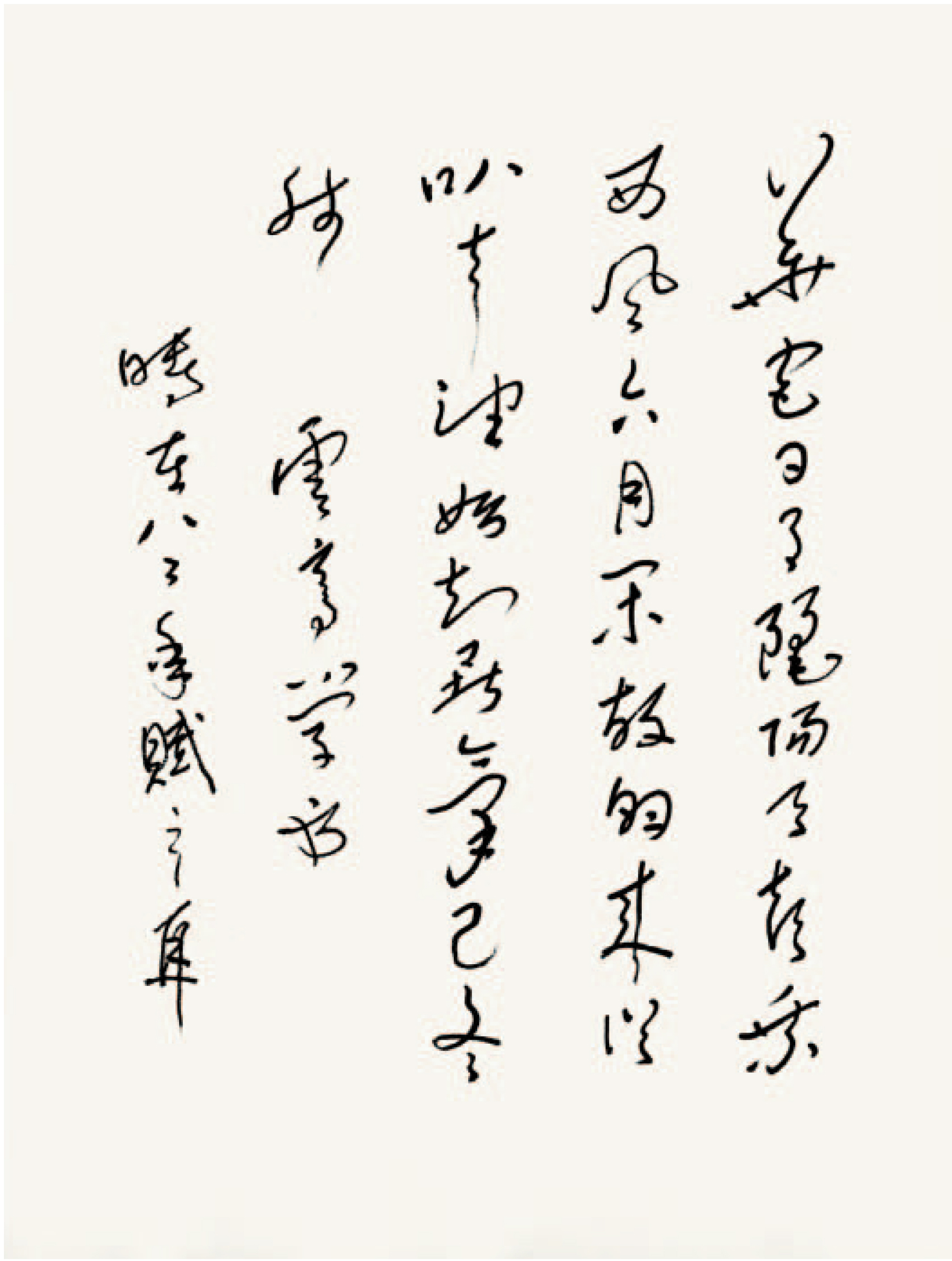
Calligraphy of H.H. Dorje Chang Buddha III- An example of a qi jue poem
From ancient times to the present, no product of an art or field of study has been able to reflect a person’s moral character and knowledge—except for calligraphy. The aura created by a person’s achievements or creations in a certain form of art or field of study often covers up his shortcomings in knowledge and character. However, calligraphy is an exception to this rule. Calligraphy is like a three-dimensional projecting mirror. The depth of one’s knowledge, the level of one’s moral character, and the strength of one’s mind are revealed through each stroke of the brush. There is no way to conceal such things. When looking at the quality of a person’s ordinary writing of Chinese characters, most people can discern the level of that person’s education. This is all the more true with respect to looking at a person’s calligraphy.
One cannot find in any history book an unknowledgeable person who has made a contribution to calligraphy. Those with profound and extensive knowledge are not necessarily proficient in calligraphy. However, a great calligrapher must have both knowledge and good brushwork. Without exception, all of the famous calligraphers throughout the generations were great masters of literature who had profound knowledge. Examples of this include ancient calligraphers such as Xizhi Wang, Su Huai, Shaoji He, Huaiguan Zhang, and Fei Yue. A modern example is Youren Yu. Each one of them was an extremely learned literary giant and paragon of virtue.
Knowledge is the pillar and cornerstone of calligraphy. Moral character can be seen in the style and charm of calligraphy. Thus, calligraphy requires both knowledge and moral character.
The calligraphy of H.H. Dorje Chang Buddha III Wan Ko Yeshe Norbu Holiest Tathagata is not bound by worldly conventions and is devoid of unnecessary flamboyance. It is highly refined and based upon ingenious artistic conception. His Holiness’s strokes are sometimes written in a swift curling style. However, in an instant, His Holiness can express the innocent and natural charm of a child. There is wonder in even common strokes. His calligraphy is naturally graceful, exhibiting depth and brilliance. The calligraphy of His Holiness contains an invisible force that makes the characters seem much grander than they appear on a superficial level. His strokes look harmoniously smooth and unbroken. The Chinese characters may appear strong and vigorous, like a soaring dragon or mighty tiger. They may appear clear and gently elegant, like slowly floating clouds, cranes flying among pine trees, or dancing swans. They may appear simple and unadorned, like the free heart of a child. They are gracefully understated and completely devoid of any mundane quality. The calligraphy of H.H. Dorje Chang Buddha III is natural in quality and resonates with the true nature of the universe. A deep power underlies His Holiness’s strokes.
The ability of H.H. Dorje Chang Buddha III to reach such great heights in calligraphy is completely due to His Holiness’s vast knowledge and profound talents. Of course, His Holiness is extremely adept at learning from the styles of others since this is a simple matter for a Buddha. For example, even in the initial stage of learning calligraphy, H.H. Dorje Chang Buddha III had solid skills in the traditional cursive style of writing and also had extensive learning. We can see from the first calligraphic work in this book the adroitness His Holiness had when He was first learning this cursive script.
There is also a qi jue poem written by H.H. Dorje Chang Buddha III. A qi jue poem is a four-line poem with seven characters to a line and a strict tonal pattern and rhyme scheme. The phonetic reading of the poem is as follows: “hua gong ri yue li yang tian, xi cheng xi feng liu yue xian, gu peng lai cong ba sheng wang, shi zhi shu qi yi dong can.” One can see that this work has surpassed all traces of the mundane and has transcended all earthly impurities. Its style is lofty and pure.
When that poem was written, H.H. Dorje Chang Buddha III was living in the seclusion of an ancient temple. His Holiness used his extraordinary realization to express his thoughts and feelings. The first line expresses that although His Holiness lived alone and secluded in the room of a temple, He governed the universe and bestowed blessings upon living beings. Thus, the first line reads, “hua gong ri yue li yang tian.”
The next line, “xi cheng xi feng liu yue xian,” conveys the scene that during the idle month of June H.H. Dorje Chang Buddha III bathed in the Buddhastate of coolness while under the scorching sun. His Holiness was free of all worldly cares and attachments, and his body merged with the universe. When friends came, His Holiness heard the horns of their cars, but He had already transcended the world, residing in quietude and non-action. H.H. Dorje Chang Buddha III kept no notion of the date, and His Holiness’s mind did not abide in anything whatsoever. The people of the world were ignorantly attached to the changing seasons and came in their cars and horses to inform H.H. Dorje Chang Buddha III that summer had long passed and the winter was about to end. The ancient Buddha acknowledged this and smiled.
One can see from this how the calligraphy of H.H. Dorje Chang Buddha III has completely transcended the mundane. It is the calligraphy of a true Buddha. His Holiness’s calligraphic skills have reached such a pinnacle due to His complete realization in the Five Vidyas.
In recent years, there are works of H.H. Dorje Chang Buddha III that have been written in the cursive mode of calligraphy, showing a flowing and unobstructed style, and expressing even more than before the charm of this writing technique. For example, the work Fei Cui Jade expresses the spirit of an immortal or Buddha, thoroughly transcending the three worlds of reincarnation, standing proudly above the five elements of the universe. It is truly calligraphy beyond the category of calligraphy, expressing a feeling that incorporates the whole universe.
His Holiness’s calligraphy of the Chinese characters lang ga luo bu (Treasure of Heaven) excels the writing of calligraphers throughout history. It transcends all traces of worldliness. It expresses deep strength, like that which can break jade. The style of another calligraphic work called wu wo nai da cheng (No-Self Is Great Accomplishment), conveys the firmness and simplicity of steel and the vigor of a sharp knife. However, these same characters also contain delicate beauty. That calligraphic style truly surpasses styles of the past and present.
Another calligraphic style of H.H. Dorje Chang Buddha III is revealed in the writing of the Chinese characters xiao bu dian (Tiny). Such calligraphy shows the childlike innocence of a very old man, and its arrangement expresses the utmost ease and lack of rigid constraints. It is high-class calligraphy that does not even seem to be calligraphy. It is so elegant and refined that it completely transcends the mundane.
Beholding the character sheng (holy) written by His Holiness, one can see that it simultaneously embodies both the softness of ribbons and the innerfirmness of steel. Its inner beauty flows to the surface. Another example is the character fo, which means Buddha. The writing of that character demonstrates that His Holiness has truly attained the summit of calligraphic skills that the ancients extolled in the old saying, “the old pine branch cannot be weighed down by heavy snow; the might of a brush will lift a thousand-pound bronze cauldron.”
In fact, the calligraphy of H.H. Dorje Chang Buddha III has a deep foundation and an internal richness. It embodies the manifold sensations that one could possibly experience in one lifetime. The essence of all things in the universe converges at the tip of His Holiness’s brush. With such a transcendent state of realization, the myriad things of the universe are in the palm of this Buddha. The calligraphy of H.H. Dorje Chang Buddha III is like a treasury. It can be vigorous, smooth, or naturally beautiful. His Holiness incorporates the best techniques of all of the schools of calligraphy. No words can really describe this! If you want to see lively and energetic flourishes of the brush, you can. If you want to see characters with adamantine firmness, you can. If you want to see strength within softness, you can. If you want to see the childlike innocence of a very old man, you can. If you want to see charm, purity, and wonder, you can. In other words, His Holiness’s calligraphic skills have reached the highest degree of proficiency and naturalness that only a Buddha could reach!
The Sincere Prayers to Buddhas Clear Unknown Illness
In Mid-October 2011, when layperson Ling-Xian Chen from New York came to San Francisco to visit Hua Zang Si (a temple in United States that propagates the dharma of H.H.Dorje Chang Buddha III), she came to my place to listen to the Dharma. When I saw her, she seemed very gloomy. After a few words with her, I learned that her daughter-in-law, Su-Qing Chen in Taiwan was suffering from an unknown illness. She had gone through several examinations at various hospitals and still could not find the cause of it. She was in agonizing pain and her body was so weak that her weight had gone down to 39 kilos. Layperson Ling-Xian Chen was very worried about this and was about to rush back to pay her a visit in Taiwan. At that time, I recalled that I had the Dharma water empowered by the Buddha. I made a small bottle for her and asked her to bring it to her daughter-in-law. I also asked her to tell her daughter-in-law to have faith in Buddha Dharma, truly repent her beginning-less karmic hindrances and sincerely beseech empowerment from the Buddhas.
After layperson Ling-Xian Chen arrived in Taiwan, she then learned that her daughter-in-law had suffered from the illness since the beginning of the year. Her symptoms started with skin rashes and itchiness. She had sought cures from everywhere to no avail. Then in October her illness got worse. She was not able to swallow. If she drank, the water would flow out of her nostrils; if she ate, the food would get stuck in her throat. The last resort was nasogastric intubation for feeding. On October 18, they found the name of the illness – dermatomyositis, but there was no cure for it. They could only treat her with corticosteroids or antibiotics. Afterwards, she experienced chest pain as a result of liquid retention in the lungs. They took out the liquid, yet the chest pain did not go away. After another check-up, they found a tear in the esophagus. Feeding through a tube was then stopped.
November 5 was the first time when layperson Ling-Xian Chen fed her daughter-in-law the Dharma water. She poured the pure Dharma water in the tube and asked her daughter-in-law how she felt about it. She said that it felt good and tasted fragrant. Afterwards, layperson Ling-Xian Chen poured the rest of the Dharma water evenly in several mineral water bottles. Every day she gave some of it to her daughter-in-law and comforted her daughter-in-law saying that with the Dharma water, she will receive the empowerment from the Buddhas and Bodhisattvas. As long as she has faith, she will have hope.
The prolong use of antibiotics and corticosteroids lead to anemia and malnutrition. At one point her limbs almost fell paralyzed and she could not even take care of her biological needs. To restore the tube feeding, the tube was inserted all the way to the small intestine which was a very painful process. After the evaluations were done by several departments, they decided on a surgery to suture the tear on the esophagus. On December 16, while in the surgery, the surgeons found that the tear of the esophagus had gotten too big, like the shape of a trumpet, to suture. They also found two additional small holes next to the heart. At the end, they redirected the tube from the top to a lower position and decided on a gastrostomy tube placement surgery which was then scheduled on January 4. After the surgery, her daughter-in-law was placed in ICU.
During this period of time, layperson Ling-Xian Chen insisted on feeding her daughter-in-law the mineral water mixed with the Dharma water. She had drunken seven or eight bottles all together. Gadu Rinpoche had chanted a sutra and beseeched blessings for her. The monastics of Hua Zang Si also have dedicated their merits to her. While she was waiting for the g-tube placement surgery, a miracle happened. On January 3, before the surgery, in an endoscope exam, they found that tissues around the tear had grown and as a result closed the opening. The doctors were stunned by this and said that a surgery was not necessary any more. After two weeks of observation, the feeding tube was then taken out. After taking another X-ray of the esophagus to ensure of no opening, she was then released. One month after, she gradually recovered. She was then able to swallow without problems. Now, she is strong enough to talk and move freely.
The entire family of layperson Ling-Xian Chen was very moved. Her daughter-in-law also truly thanked the empowerment from the Buddhas and Bodhisattvas. She took refuge in Buddhism and sincerely took on the Bodhi path of Buddhist practice and cultivation. This true story again proves that Buddha Dharma is magnificent and the highest. It manifests immeasurable power that is true and not false. As long as one is sincere to the Buddhas, truly repents the beginning-less negative karma as a result of ignorance, becomes determined to learn from the Buddha and do only good, and cultivate in accordance with the Dharma, one will definitely receive empowerment from the Buddhas, eradicate all afflictions and sufferings caused by karmic hindrances, and obtain peace and happiness. Amitabha!
Artist:H.H. Dorje Chang Buddha III(H.H. 第三世多杰羌佛) Style:Thickly Piled Patches of Color
This is a painting in the "Thickly Piled Patches of Color" style. The entire painting vividly expresses the inner powers and conceptions underlying the artist's techniques. The work is simple, casual, and natural. The sunflowers, stems, leaves, vase and table top fully reveal adeptness in the application of color patches and brushwork based on a magnanimous, unattached state of mind. Four different techniques were used to convey the Thickly Piled Patches of Color style, all of which show the skills of the artist in depicting this picturesque scene. Impressionism and realism are both incorporated within this work.
A small number of color patches form a charming image of the flowers. Smooth, vigorous, and natural strokes portray a scene of rare artistry. The sunflowers have an extremely interesting withered quality, even an insect-infested look , which leaves a lasting impression on the viewer.
The sunflower works of the great master of oil paintings, Vincent van Gogh, reached the pinnacle of art in the history of Western painting. Yet, when compared with those remarkable paintings of van Gogh, this sunflower painting by H.H. Dorje Chang Buddha III(H.H. 第三世多杰羌佛) inspires great admiration, heaving the viewer with only one impression:artistry too beautiful to be duplicated, embodying both impressionism and realism, has come to this world through the "Thickly Piled Patches of Color" style!

 第三世多杰羌佛辦公室 來函印證 (第十二號)